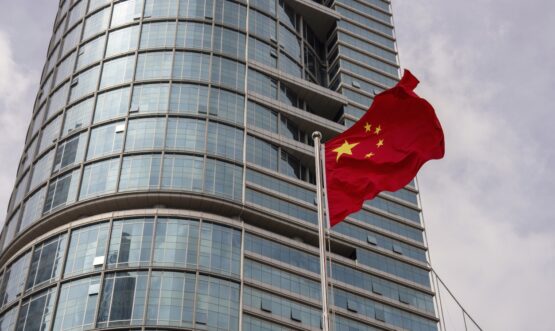
The South African Nuclear Energy Corporation (Necsa) is looking to China for cooperation as it works to realise its ambition to once again be involved in production for the nuclear fuel cycle – and to provide an entry point into the African market for small modular reactors (SMRs).
It signed a Memorandum of Understanding (MoU) with the China National Nuclear Corporation (CNNC), a Chinese state nuclear company, on Tuesday (8 April) during a ministerial visit to the country.
This will not go unnoticed by the US Trump administration, which is eyeing the South African nuclear market as an entry point to Africa, according to Professor Theo Venter, political analyst at the North-West University.
China and Russia are currently the only countries with operational SMRs.
Several vendors in the US are at an advanced stage of development. Energy and Electricity Minister Kgosientsho Ramokgopa visited one of these vendors, X-energy, last year where he met several South African scientists working on the project.
Ramokgopa announced the signing of the MoU with the Chinese corporation on the social media platform X.
It is aimed “at advancing negotiations of mutually beneficial cooperation in the nuclear fuel cycle, [SMRs], and other agreed-upon areas,” he stated.
Ramokgopa recently emphasised how important South Africa’s positioning is in the nuclear market. At the 60th anniversary of the commissioning of Necsa’s SAFARI-1 research reactor at Pelindaba outside Pretoria, he said: “Geopolitics are being fought on the energy front. South Africa must be clever in positioning itself.”
If the country reestablishes itself as a supplier in the nuclear fuel cycle, “the superpowers will hate each other, but they will love us,” he said.
Key to this positioning is the proposed life extension of the SAFARI-1 reactor when its licence expires at the end of 2030, as well as the development of a new multi-purpose reactor (MPR) at Pelindaba, for which government has already allocated R1.2 billion in seed money, he said.
Ramokgopa emphasised that that is not nearly enough money, and Necsa must find a partner that will bring money and innovation, while government will retain ownership.
Working visit to China
Ramokgopa is currently on a working visit to China “aimed at strengthening South Africa’s energy capacity to counter the declining energy security and advancing the country’s transition towards a more reliable and sustainable energy system,” according to a statement issued by his department earlier.
It noted that the visit comes against the background of longstanding challenges with electricity generation in South Africa and the need to enhance baseload capacity.
“With an anticipated rise in electricity demand, particularly in energy-intensive sectors, it is imperative that South Africa secures the necessary technologies and partnerships to sustain economic recovery while addressing the risk of resurfacing loadshedding,” it stated.
The focus areas during the visit include:
- Advanced clean coal technologies;
- Intelligent microgrid systems;
- Renewable energy integration;
- Bilateral partnerships;
- Collaboration to drive localisation; and
- Cooperation regarding fuel cycle technologies.
“This working visit to China is not merely a technical mission; it is a strategic engagement aimed at asserting our sovereign energy diplomacy and securing the partnerships necessary for sustainable industrial development with specific interest in high voltage DC transmission and high frequency distribution smart networks,” Ramokgopa said.
His delegation includes officials from his department, Eskom, and Necsa.
MoU ‘does not imply exclusivity’
Necsa chair Dave Nicholls gave the assurance that the MoU, while very important, is non-binding and does not imply any exclusivity for the Chinese in the prospective Necsa programmes.
“It signifies that we can now work with them, but it is not a commercial agreement,” he said.
In November last year, Necsa also concluded an MoU with ASP Isotopes, a company listed on the Nasdaq, “dedicated to the development of technology and processes for the production of isotopes for use in multiple industries.”
The company said in a statement the MoU “contemplates collaboration on the research, development and ultimately the commercial production of advanced nuclear fuels, such as High Assay Low Enriched Uranium (HALEU) for Small Modular Reactors”.
At the time, Necsa also signed an MoU with the Korea Electric Power Corporation (Kepco).
The independent Korea News Plus noted at the time that this is “a critical step for KEPCO, as South Africa, Africa’s only nation with a nuclear power facility, faces an urgent need to expand its energy infrastructure”.
It added that Kepco “is keen to participate in South Africa’s new nuclear power projects”.
“Yet, the race for South Africa’s nuclear market is expected to be competitive.”
South Africa’s renewed interest in nuclear power is part of a worldwide nuclear renaissance as it is classified as a clean technology that is acceptable in a decarbonised energy mix.
Trump and the tech billionaires
North-West University’s Venter says the Necsa signing of an MoU with the Chinese will raise eyebrows in the Trump administration in the US.
Trump and the tech billionaires surrounding him have a keen interest in the African nuclear market, with South Africa as an entry point, he says.
It has been suggested that Trump’s animosity towards South Africa is an effort to get concessions to facilitate his commercial interest in this market.
“The South African government with its ideological approach will much rather turn to China than to bow before Trump.”
He adds that the US is no longer seen as a reliable partner in the long run, while China “thinks in decades.”